Story first. Intelligence next.
Every company deserves to know if their Story is clear enough to Win.
Most B2B software companies don't - the ones selling platforms, tools, and technology to other businesses. Most have never tested.
Seven dimensions. Five forces. One diagnostic. The strategic foundation your entire go-to-market depends on - examined, scored, and made actionable.Every dollar spent on execution without a validated story foundation is a dollar that might be amplifying confusion instead of clarity.
$5,000 one-time investment
No call required.
Built on 16 Years of Field Experience

"He was able to weave a thoroughly compelling solution story about the business impact of our products and also answer a surprising number of technical questions with ease."
Jeff Whatcott, CMO, Brightcove
"Very good strategist, well prepared to understand real business issues and provide a compelling solution match. He has a good ear for what customers are looking for."
Serge Froidevaux, Global Client Director, ServiceNow
"Outstanding coaching capacity. He has definitely added a key value on defining a proper storytelling on our approach to our investors and customers."
Victor Carbonell, CRO, NPAW
Whether you call it positioning, messaging, or homepage copy -
if buyers can't tell you apart from competitors, your story is broken.
THE PROBLEM
Buyers decide in seconds.
AI decides even faster.
Your buyers don't read your homepage top to bottom. They scan for three things: do you understand my problem, can you solve it, and should I trust you. If the answer isn't obvious in 10 seconds, they leave. You never know they were there.There's a second audience doing the same thing. When your buyers ask Perplexity or ChatGPT "what's the best platform for {your category}", those AI systems scan your story too. Unclear story? You don't get recommended. Your competitors do.KubrickLENS™ makes both problems visible and measurable - before they cost you another deal.
THE VISION
Your competitors are already being recommended. Are you?
1 in 2 B2B buyers now use AI to build their vendor shortlists before they ever visit your website (Forrester, 2025). If your story isn't clear enough for those machines to parse, you're not on the list. You don't get a second chance to be discovered.The goal isn't a better website. It's story independence:Your story sells without you in the room. AI recommends you without being asked. Buyers arrive already knowing why you're the right choice.Why? Because AI systems don't recommend feature lists. They recommend stories built on buyer pain. When your story leads with the buyer's problem in their language, LLMs match you to real buyer queries at dramatically higher rates. A Search Engine Land audit of 15 domains found that 72.4% of content cited by ChatGPT contained self-contained “answer capsules” that directly address a buyer's question. Content that buries the answer under feature descriptions was almost never cited. Pain-focused pages convert at 3.5% versus 1.8% for generic industry pages - a 94% improvement (FirstPageSage, 2026).And when companies achieve that clarity, the entire ecosystem shifts. AI platforms recommend you because they can parse why you're different. Your GTM tools perform better because they're finally delivering a message that lands. Your agencies build on solid foundations instead of guessing. Clarity flows downstream to everything.But here's the problem: every tool, every agency, every AI workflow assumes your story is already solid. Almost nobody tests whether it actually is.KubrickLENS is the first diagnostic that does. Diagnose before you deploy.
The Shift
The window is closing faster than you think.
In 2024, generative AI was a new option in Forrester's B2B buyer survey. By 2025, it had become the single most cited research tool for B2B purchases. That's not a trend. That's a replacement cycle.The numbers tell the story: 60% of searches now end without a click. AI-referred visitors convert at 3x the rate of traditional search. Gartner projects AI agents will intermediate $15 trillion in B2B spend by 2028. Companies that show up clearly in AI-powered discovery right now are capturing the buyers that companies with unclear stories will never see.Every quarter you wait, the gap widens. Not because AI gets smarter - but because your competitors with clearer stories get further ahead.
Seven Dimensions
What KubrickLENS measures
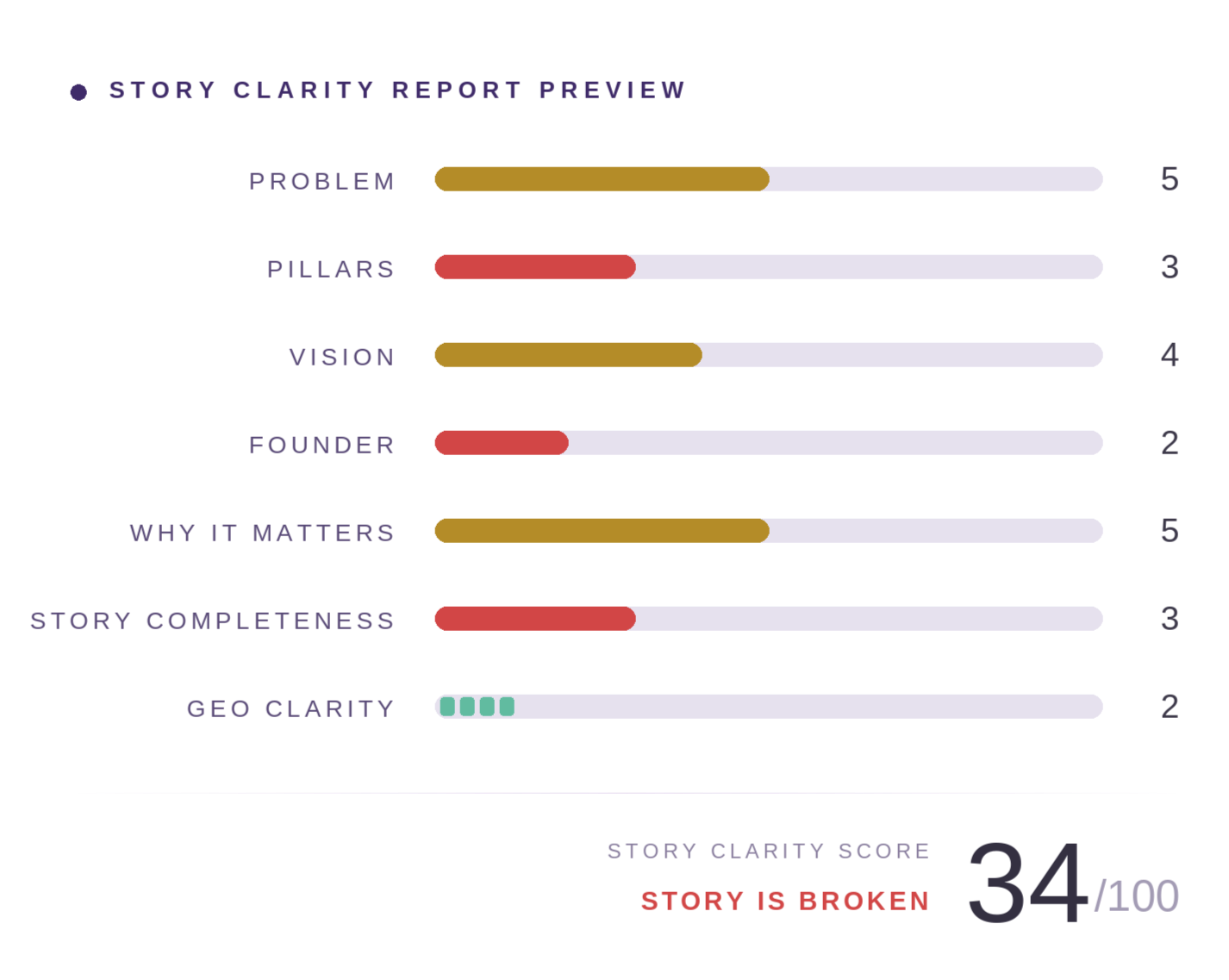
Every B2B software company tells itself a story about why buyers should choose them. KubrickLENS tests whether that story actually lands - across seven dimensions that separate companies with stories that sell from companies lost in the noise.Why seven? After diagnosing B2B SaaS companies across industries, stages, and geographies, we found that stories break in seven predictable places. Miss any one and the entire story wobbles. Score well across all seven and your go-to-market starts compounding instead of leaking.

01
The Problem You See
Do you have a unique market insight, or do you sound like every other vendor in your category? The strongest companies lead with the problem they see that others miss.
02
The Pillars
System thinking? Story moat? Precision targeting? Your pillars are the structural supports that make your solution defensible - not a feature list, but a strategic architecture.
03
The Vision
Can you articulate what you're building - not features, but transformation? The best founders paint a future that pulls buyers forward rather than pushing product.
04
Founder's Statement
One paragraph. Does it land? Your founder's story is your most underused trust signal. Buyers want to know why you care about this problem - not just that you built a product.
05
Why It Matters
Is your messaging customer-centric or company-centric? When buyers read your site, do they see their own pain reflected back - or just your features described from your perspective?
06
Story Completeness
WHAT you do, FOR WHOM, WHEN it matters, WHY NOW, WHY you, and the OUTCOME. Six questions. If a first-time visitor can't answer all six in 30 seconds, your story has gaps.
07
GEO Clarity Score
Generative Engine Optimization - When buyers ask Perplexity, ChatGPT, Claude, or Gemini for solutions in your category, do you show up - and can the AI explain why you're different? We test your story against real buyer pain queries and show you exactly how AI sees you versus competitors. If AI can't parse why you're different, you're invisible to the fastest-growing buying channel in B2B (49% of buyers already use AI to build shortlists - Forrester).
* Dimensions 1-5 synthesize principles from Storynomics (Robert McKee, 25 years of global practice) and pain-based segmentation methodology (Cannonball GTM). Dimension 6 draws from established positioning theory (Ries & Trout, Moore, Dunford). Dimension 7 is based on empirical research into how LLMs evaluate and recommend B2B software - including citation audits across major AI platforms (Search Engine Land, Digital Bloom 2025 AI Citation Report) showing that semantic relevance to the buyer's question, not backlinks or domain authority, determines whether AI recommends you.
Text
KubrickLIGHTING
What the environment reveals
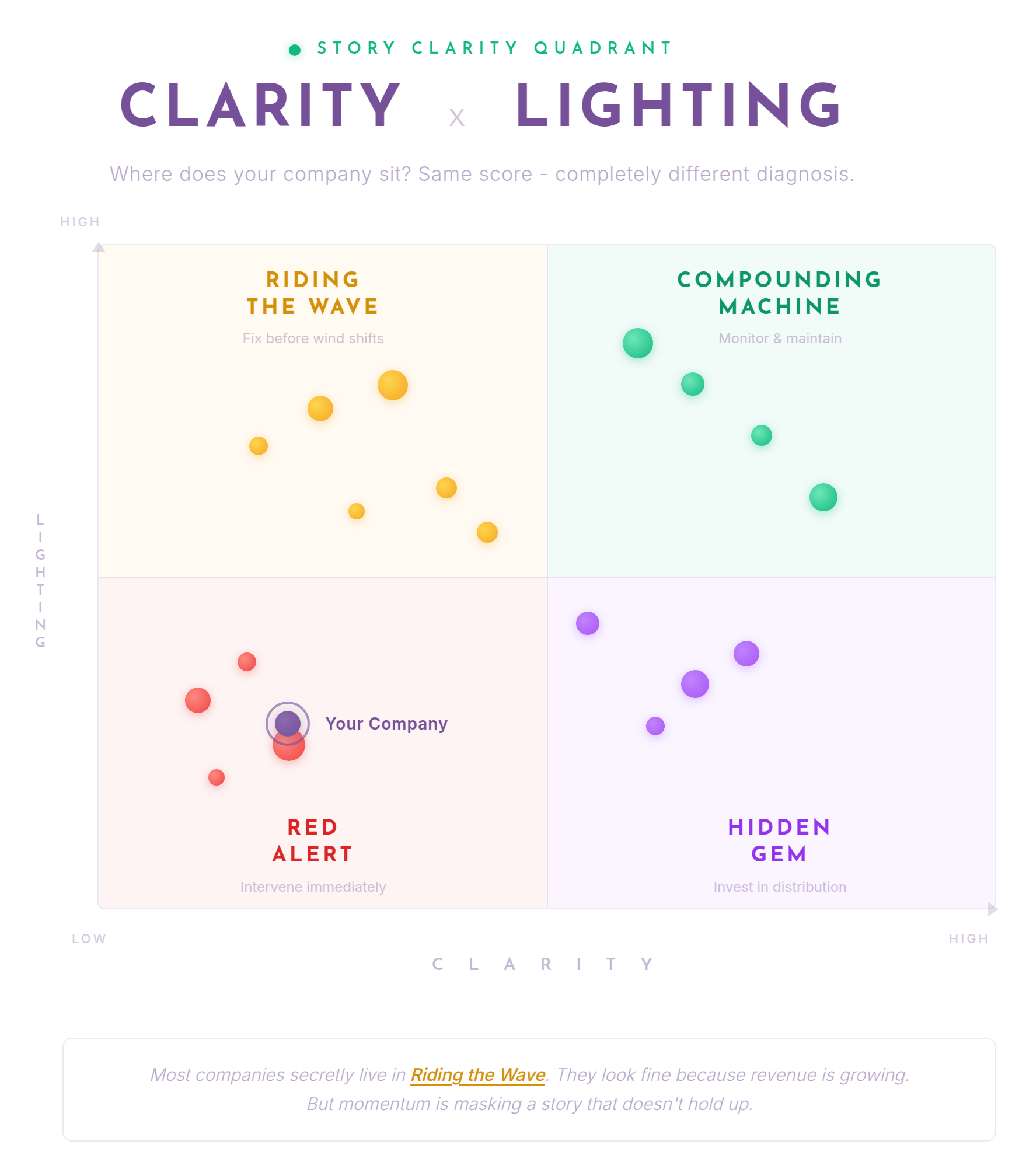
Your score only tells half the story. A company scoring 55 with massive brand love, an active community, and high market awareness is succeeding despite story gaps - there's upside they're not capturing. A company scoring 55 with none of that is at its ceiling. Same score. Completely different diagnosis.
KubrickLENS doesn't just score your story. It scores the environment around it.
KubrickLIGHTING measures the five market forces that amplify or mask your story clarity - so you know whether your number is a springboard or a warning sign.
01
Market Awareness
Does the market know you exist? Traffic, brand search volume, presence on review platforms versus your direct competitors.
02
Love Brand Index
Do users love your product beyond reason? Review sentiment, unsolicited mentions, the emotional language buyers use when nobody's watching.
03
Community Gravity
Is there a community pulling people toward you? User groups, forums, event presence, organic advocacy that exists without your marketing budget.
04
Ecosystem Integration
Is your product embedded in the workflows around it? Marketplace listings, partner-built integrations, the connective tissue that makes your product hard to rip out.
05
Hiring Signal
Is the company investing in growth? Headcount trajectory, open roles, and whether the talent signals match the story being told.
Each factor scored 1-5 against your peer group - companies in your category, at your stage, with your motion type. Your KubrickLIGHTING profile shows up alongside your CLARITY score in every Story Clarity Report.
Same scene. Different lighting reveals different things. That's why every KubrickLENS diagnostic includes both layers.
* KubrickLIGHTING factors are scored using normalized public signals benchmarked against category peers. Each factor uses a 1-5 scale where 1 = bottom 20th percentile, 3 = category median, and 5 = top 20th percentile within the relevant peer set.
Most companies don't know where their story breaks.
They invest in tools, teams, and automation - but never examine the foundation underneath. KubrickLENS makes the invisible visible. The story gaps you can't see are the deals you can't win.
Where do you fall? Most B2B SaaS companies land further left than they expect. The cost of staying there: longer sales cycles, higher CAC, losing deals to competitors who explain the problem better - not solve it better. For a company spending $200K+ per year on GTM, even a 15% efficiency gain from clearer story pays for the diagnostic 6x over.
This is not message testing. This is not a positioning workshop.
This is the diagnostic that comes before both.
How It Works
Platform-powered diagnosis. Strategist-led insight.
KubrickLENS handles the analytical heavy lifting. The strategist handles the judgment calls that templates and AI alone can't make. You get both in one engagement.
01
We audit your story
Your website, messaging, and competitive landscape - scored across all seven dimensions with evidence blocks for every finding.
02
We test your AI visibility
Real buyer pain queries run through Perplexity, ChatGPT, Claude and Gemini. You see where you rank and why AI recommends your competitors instead.
03
You get your Story Clarity Preview
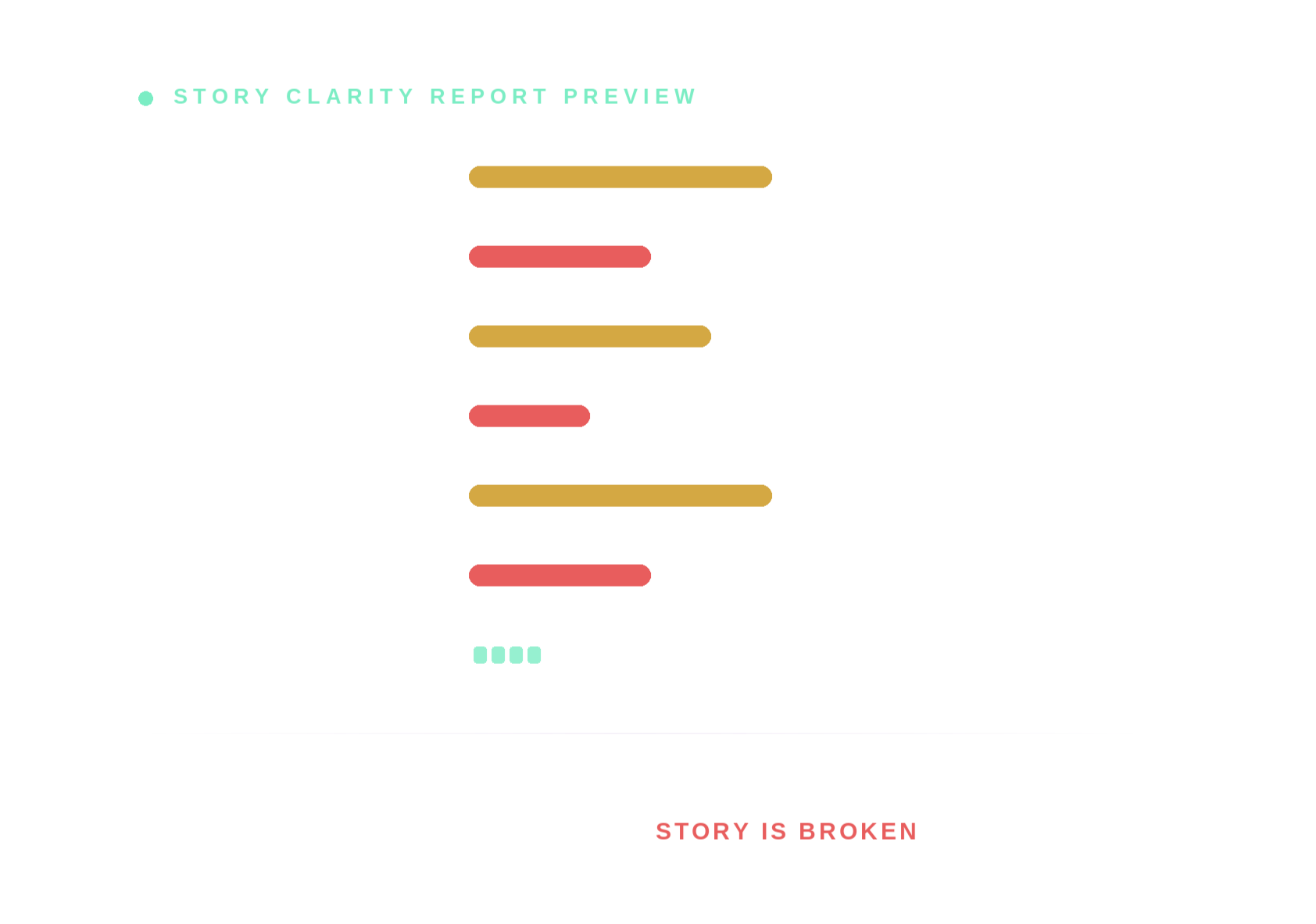
A complimentary snapshot of your scores and one fully revealed dimension, so you can see the quality before you commit.
04
You get your Story Clarity Report
Dimension scores. Evidence. GEO competitive snapshot. Prioritised recommendations. And the strategic bridge into fixing what's broken.
Who This Is For
Built for vertical B2B software founders who know something's off
You sell a technology platform, software, or app to other businesses in a specific industry. Your product is strong. Your story isn't keeping up.
Your website sounds like everyone else in your category
Swap your logo with a competitor's and nobody notices. KubrickLENS shows you exactly where the "sea of sameness" starts.
You're losing deals you should be winning
The product is strong but the story isn't landing. Buyers choose competitors who explain the problem better - not the ones who solve it better.
You're invisible to AI-powered discovery
When buyers ask Perplexity or ChatGPT for recommendations in your vertical, your competitors show up. You don't. And you had no idea it was happening.
You've outgrown your original story
The story that got you your first 20 customers won't get you your next 200. You need a clear diagnostic before you rebuild.
You're about to make a major GTM investment
Before you hire the VP Marketing. Before you pick the agency. Before you automate outbound. Before you announce the round. Before you expand to a new ICP. Diagnose first. Every dollar spent on execution without a validated story foundation is a dollar that might be amplifying confusion instead of clarity.
The Field Evidence
Where Story Clarity Was My Problem to Solve
US Marketing sent feature-driven decks. I sold across Southern Europe and Latin America - markets where those decks wouldn't close a single deal. Every year, new products, new regions, acquisitions, rebranding, pivoting messaging, expanding ICPs. I rebuilt the story in the field for 16 years - acting as a field product marketing manager from a seller's chair - because the existing story wouldn't sell. KubrickLENS is the diagnostic version of what I did manually under quota pressure at every one of these companies.

The Origin Story
24 Websites. Same Jargon. One Diagnostic.

Nicolás Amado Vega
Revenue Growth Engineer - 9x Founder
In 2024, while running competitive intelligence for a customer at Humengine, I had to evaluate 24 competitor websites in the RevOps space. Same industry. Same event. Same buyer. After 18+ years as an enterprise B2B SaaS seller - from startup to IPO, Nasdaq-listed, two acquisitions at Brightcove, four years as regional director at New Relic, vertical SaaS at Sitetracker - I couldn't figure out what most of them were selling. Same jargon. Same structure. Same feature lists written from the inside out. Swap the logos and nobody would notice. That was the moment KubrickLENS became inevitable. If a veteran enterprise seller can't tell 24 companies apart, buyers don't stand a chance.
But the pattern started long before that. For 16 years I was the person who had to fix the story in the field. US headquarters would ship feature-driven decks. I'd take them into Southern European and Latin American markets where that approach wouldn't survive the first meeting. Different cultures. Different buying dynamics. Different ways of building trust. So I rebuilt the story - every product launch, every regional expansion, every acquisition, every pivot - from the seller's chair, under quota pressure, with real consequences if I got it wrong. I wasn't a consultant observing from outside. I was the person inside the company who had to make the story work or miss the number.
The narrative architecture underneath KubrickLENS comes from 25 years of training with Robert McKee, starting with his Storynomics seminars in Madrid in 2001. The same story structure principles that make great films unforgettable are the principles that make B2B stories stick. That's not a metaphor - it's the methodology. Story structure is how humans decide what matters. KubrickLENS applies it to how companies tell their market story.
That is what KubrickLENS is built on. Not theory. Sixteen years of diagnosing and fixing story problems in the field, combined with 25 years of storytelling craft. It integrates six specialties - positioning, narrative strategy, ICP research, competitive intelligence, copywriting, and AI-powered discovery - under one methodology. And the urgency has never been higher. AI buying agents are already evaluating and recommending vendors before a human reads your website. KubrickLENS shows you exactly how those machines see you - not just how buyers do. You work directly with me. No handoffs. No junior team. One senior strategist who built the system because he was tired of watching the same problems go unsolved.
Capability Stack
18+ years leading B2B SaaS enterprise sales across EMEA & LATAM - 16 years rebuilding stories in the field as a de facto product marketing manager - 2+ years architecting AI-driven GTM systems - 25 years refining storytelling craft with Robert McKee (since Madrid, 2001) - 9x founder
Career Anchors
Brightcove (startup to IPO, Nasdaq-listed, 2 acquisitions) - AccedoTV (OTT video/streaming) - New Relic (enterprise observability) - Sitetracker (vertical SaaS, construction technology) - Humengine (full GTM build)
See what your story is costing you - before it costs you more.
One week. Seven dimensions. A diagnostic you can act on.
Your Story Clarity Report includes dimension-by-dimension findings with evidence for every insight, a GEO competitive snapshot showing how AI sees you versus named competitors, a prioritized fix list ordered by revenue impact, and the strategic bridge into fixing what's broken.
One senior strategist. One week.
One document that changes how you see your entire go-to-market.
The typical cost of rebuilding a GTM motion on an unclear story: $150-250K in wrong hires, wasted agency fees, and stalled pipeline.
The diagnostic that prevents it: one week and one decision.
$5,000 one-time investment.
No call required. Tell us your URL and we get to work.
Early-stage founder building on a tight budget?
Every vertical B2B SaaS company deserves to know
where their story breaks - regardless of stage. Let's talk.
FAQs
My messaging isn't landing. My positioning feels off. Is that what this helps with?
Exactly. If you've lost deals where buyers said "we couldn't tell the difference between you and the competitor" - or your sales team keeps saying the product is strong but the story doesn't land - that's a story clarity problem. It goes by different names: positioning problem, messaging problem, homepage problem. KubrickLENS gives it a score. Seven dimensions, 0-100, with evidence for every finding. You stop guessing where the story breaks and start knowing.
How much does it cost?
$5,000 (or EUR 4,600). One-time investment. You get the complete diagnostic across all seven dimensions, the KubrickLIGHTING environmental profile, the GEO competitive snapshot, the Sea of Sameness competitive analysis, a complete evidence registry, and three prioritized strategic decisions.
Can't I just use ChatGPT to audit my own website?
You can, and you'll get generic feedback. Here's what you won't get: a calibrated scoring methodology tested across multiple companies. A competitive Sea of Sameness analysis showing exactly which of your claims are interchangeable with competitors. A GEO visibility test across four AI platforms with real buyer pain queries. Or the judgment of a strategist with 18+ years of B2B SaaS field experience who can tell you "fix Dimension 6 before you touch anything else - because your missing WHY NOW is the reason your outbound isn't converting, not your subject lines."
ChatGPT tells you your messaging "could be clearer." KubrickLENS tells you exactly where it breaks, what to fix, how to fix it, and in what order - so you get the highest-impact wins first.
What do I need to provide?
Nothing. The diagnostic is based entirely on your publicly available website and messaging. We don't need interviews, internal documents, or your team's time. If you want to suggest specific competitors for the Sea of Sameness analysis, you can - otherwise we identify the most relevant ones.
How is this different from message testing?
Different tool, different job. Message testing asks real buyers what they think of your current messaging - it's post-hoc validation. KubrickLENS diagnoses WHERE and WHY your story breaks before you test it. The scored framework shows you which dimensions are weakest, how you compare to competitors, and whether AI assistants can even find and recommend you.
Think of it this way: message testing tells you if buyers like what they see. The diagnostic tells you what's structurally broken underneath. Best results come from diagnosing first, then testing after you've fixed the structural gaps.
Have more questions? Read the full FAQs.
KubrickLENS
Story first. Intelligence next.
KubrickLENS™ is a story clarity diagnostic platform for B2B software companies - technology platforms selling to other businesses.
by Make Buying B2B Easy.© Storyaffair SLU. - Nicolás Amado Vega. All rights reserved.
HEADQUARTERS
Avda. Cerdanyola, 75-77, 1st floor, 08172 - Sant Cugat del Vallès, Barcelona, Spain.
Story first. Intelligence next.
Get Your Free Story Clarity Preview
Tell us about your company.
If it's a fit, we'll send you a complimentary
Story Clarity Preview.
No call required.

Cheers,
Nicolás Amado Vega
Revenue Growth Engineer - 9x Founder
KubrickLENS
Story first. Intelligence next.
KubrickLENS™ is a story clarity diagnostic platform for B2B software companies - technology platforms selling to other businesses.
by Make Buying B2B Easy.© Storyaffair SLU. - Nicolás Amado Vega. All rights reserved.
HEADQUARTERS
Avda. Cerdanyola, 75-77, 1st floor, 08172 - Sant Cugat del Vallès, Barcelona, Spain.
Story first. Intelligence next.
Frequently Asked Questions
Everything you need to know about how Story Clarity Reports work, what you get, and whether it's the right fit for your company. If your question isn't here, reach out - we reply to every message.
1. My messaging isn't landing. My positioning feels off. Is that what this helps with?
Exactly. If you've lost deals where buyers said "we couldn't tell the difference between you and the competitor" - or your sales team keeps saying the product is strong but the story doesn't land - that's a story clarity problem. It goes by different names: positioning problem, messaging problem, homepage problem. KubrickLENS gives it a score. Seven dimensions, 0-100, with evidence for every finding. You stop guessing where the story breaks and start knowing.
2. What exactly is a Story Clarity Report?
It's a scored diagnostic of your company's public-facing story - your homepage, product pages, about page, the competitive landscape, and how AI assistants see you. Seven dimensions scored on a 0-100 scale. Each score backed by specific evidence quoted from your own website. A competitive Sea of Sameness analysis that shows which of your claims are interchangeable with competitors. A GEO visibility snapshot showing how Perplexity, ChatGPT, Claude, and Gemini describe you vs. your competitors. And three prioritized strategic decisions you can act on immediately.
3. Who is this for?
B2B software companies - the ones selling platforms, tools, and technology to other businesses. If you sell into a specific industry (construction, logistics, healthcare, fintech, manufacturing), this was built for you. The sweet spot: companies between $1M-$10M ARR who are investing in growth and need to know whether their story foundation can support it. If you're a consumer app, a marketing agency, or a services company, this isn't the right tool.
4. What are the seven dimensions?
1. The Problem You See - Do you have a unique market insight, or do you sound like every other vendor? 2. The Pillars - Is your solution a connected system, or a disconnected feature list? 3. The Vision - Can you articulate transformation, or are you selling features? 4. Founder's Statement - Can a visitor know who built this and why? (Score 0 if missing.) 5. Why It Matters - Is your messaging about the customer's world, or about how great you are? 6. Story Completeness - Can a first-time visitor answer WHAT, FOR WHOM, WHEN, WHY NOW, WHY YOU, and OUTCOME in 30 seconds? 7. GEO Clarity Score - When buyers ask AI assistants for solutions in your category, do you show up? Can the AI explain why you're different?
Each dimension is scored 1-10. Total score out of 70, converted to a percentage. Plus your KubrickLIGHTING environmental profile alongside it.
5. What is KubrickLIGHTING?
Your story clarity score only tells half the picture. A company scoring 55 with massive brand love and an active community is succeeding despite story gaps - there's upside they're not capturing. A company scoring 55 with none of that is at its ceiling. Same score, completely different diagnosis.
KubrickLIGHTING measures five market forces - Market Awareness, Love Brand Index, Community Gravity, Ecosystem Integration, and Hiring Signal - each scored 1-5 against your peer group. Your LIGHTING profile appears alongside your CLARITY score in every report, so you know whether your number is a springboard or a warning sign.
6. How is this different from message testing?
Different tool, different job. Message testing asks real buyers what they think of your current messaging - it's post-hoc validation. KubrickLENS diagnoses WHERE and WHY your story breaks before you test it. The scored framework shows you which dimensions are weakest, how you compare to competitors, and whether AI assistants can even find and recommend you.
Think of it this way: message testing tells you if buyers like what they see. The diagnostic tells you what's structurally broken underneath. Best results come from diagnosing first, then testing after you've fixed the structural gaps.
7. How is this different from hiring a positioning consultant?
A positioning consultant helps you BUILD new positioning from scratch through workshops, interviews, and strategy sessions. That work typically takes 2-12 weeks and costs $10,000-$50,000+.
KubrickLENS does something different: it DIAGNOSES where your current story is breaking, using only the evidence your buyers actually see. We don't rebuild your positioning - we show you exactly what's broken, what to fix first, and how AI sees you versus competitors. Many companies don't need a full rebuild. They need to know where the three biggest gaps are so they can act this quarter.
And if you DO need a full rebuild, the diagnostic gives your consultant or agency a scored baseline to start from - instead of opinions.
8. How is story clarity different from positioning??
Positioning is what you build. Story clarity is what you measure. KubrickLENS doesn't rebuild your positioning - it scores whether the positioning you have is actually landing with buyers and AI. A company can go through a full positioning exercise and still score 30/100 on story clarity because the positioning never made it to the homepage in a way buyers can parse. The diagnostic tests what's actually visible, not what's in your strategy deck.
9. What's the GEO Clarity Score? Why should I care?
GEO stands for Generative Engine Optimization. 1 in 2 B2B buyers now use AI assistants to build their vendor shortlists before ever visiting your website (Forrester, 2025). When someone asks Perplexity "what's the best project management platform for construction companies?", does your company show up? Is the description accurate? Or does the AI recommend your competitor instead?
We test your story against real buyer pain queries across Perplexity, ChatGPT, Claude, and Gemini - and show you exactly how each AI sees you versus named competitors. If AI can't parse why you're different, you're invisible to the fastest-growing discovery channel in B2B. Research shows 72.4% of content cited by ChatGPT uses self-contained answer capsules that directly address a buyer's question - content that leads with features instead of buyer pain is almost never cited (Search Engine Land / Gorilla Marketing USA).
10. Why GEO and not AEO (Answer Engine Optimization)?
AEO optimizes for answer boxes and featured snippets inside search engines - it's still a search paradigm. GEO measures something different: whether generative AI models can parse your story well enough to recommend you when buyers ask open-ended questions like "what's the best platform for managing construction projects?" That's not a keyword search. That's a conversation. Different mechanism, different optimization, different results to measure.
11. How much does it cost?
$5,000 (or 4.500 €). One-time investment. You get the complete diagnostic across all seven dimensions, the KubrickLIGHTING environmental profile, the GEO competitive snapshot, the Sea of Sameness competitive analysis, a complete evidence registry, and three prioritized strategic decisions.
12. Why $5,000?
The typical cost of rebuilding a GTM motion on an unclear story is $150-250K in wrong hires, wasted agency fees, and stalled pipeline. The diagnostic costs less than one month of a mid-level marketing hire - and it tells you whether that hire's work will land or disappear.
Most companies know something's off. The difference between knowing you have a problem and knowing which problem to fix first is the difference between guessing and acting.
Every claim in the report is backed by evidence quoted from your own website. Every score has a documented scoring criteria. Every recommendation is specific to your company - not a template applied to your logo.
13. Can't I just use ChatGPT to audit my own website?
You can, and you'll get generic feedback. Here's what you won't get: a calibrated scoring methodology tested across multiple companies. A competitive Sea of Sameness analysis showing exactly which of your claims are interchangeable with competitors. A GEO visibility test across four AI platforms with real buyer pain queries. Or the judgment of a strategist with 18+ years of B2B SaaS field experience who can tell you "fix Dimension 6 before you touch anything else - because your missing WHY NOW is the reason your outbound isn't converting, not your subject lines."
ChatGPT tells you your messaging "could be clearer." KubrickLENS tells you exactly where it breaks, what to fix, how to fix it, and in what order - so you get the highest-impact wins first.
14. How long does it take?
One week from kickoff to delivery. One senior strategist. No handoffs. No junior team.
15. What do I need to provide?
Nothing. The diagnostic is based entirely on your publicly available website and messaging. We don't need interviews, internal documents, or your team's time. If you want to suggest specific competitors for the Sea of Sameness analysis, you can - otherwise we identify the most relevant ones.
16. Do you have case studies?
KubrickLENS is a new diagnostic built on 16 years of field practice. The methodology synthesizes 25+ years of storytelling principles (Robert McKee), pain-based GTM strategy, and established positioning frameworks (Ries & Trout, Moore, Dunford) into a single scored system. The strategist behind it spent 18 years in B2B SaaS enterprise sales at companies like Brightcove, New Relic, Accedo and Sitetracker - rebuilding stories in the field under quota pressure, not from the outside looking in.
The free Story Clarity Preview lets you see the quality and specificity of the analysis before committing to the full report.
17. What if our score is really low?
A low score isn't a judgment - it's a diagnosis. Most first-time scores land between 20-45 out of 100. That's normal. B2B software companies are built by people who are brilliant at the product but have tunnel vision about their own story - describing it from the inside out while buyers need to understand it from the outside in.
A low score means you now know exactly where the story breaks. That puts you ahead of every competitor who's still guessing.
18. Is this relevant if we already have an agency or consultant?
Possibly more so. A scored diagnostic gives your consultant or agency something they almost never get: an objective, evidence-based baseline. Instead of starting from "let's do a messaging workshop," they can start from "Dimension 3 is 2/10, Dimension 6 is 4/10, here's the specific evidence, fix these first." It makes their work faster, more focused, and more measurable.
19. What happens after I get the report?
That's up to you. Three paths:
1) You take the three strategic decisions and the prioritized fix list and execute internally. 2) You use the scored report to brief your existing agency, consultant, or team with evidence-based direction instead of opinions. 3) Or you talk to us about what comes next - the report itself will make that conversation very specific.
The report is yours. No lock-in. Use it however it creates the most value.
20. When is the right time to do this?
Before you make any major GTM investment. Before you hire the VP Marketing. Before you pick the agency. Before you automate outbound. Before you announce the round. Before you expand to a new ICP.
And especially if you're about to relaunch your website - or just did. That's when the investment is freshest and corrections are cheapest.
Every month with an unclear story is a month of marketing spend landing on a broken foundation, outbound messages that don't convert, and AI assistants describing you incorrectly to potential buyers. The diagnostic costs less than one month of a mid-level marketing hire.
21. Isn't it circular to use AI to test AI readiness?
Fair challenge. KubrickLENS addresses this in three ways. First, the GEO test runs across four different AI models (Perplexity, ChatGPT, Claude, Gemini) - when they disagree about you, that itself is a signal that your story is ambiguous enough that different "readers" interpret it differently. Second, the GEO dimension is one of seven - the other six are scored on principles that predate AI entirely (story structure, positioning theory, buyer-centric messaging). Third, this is a floor test: if AI can't parse why you're different, a busy VP with 47 unread emails has no chance. Passing the AI test doesn't guarantee success - failing it guarantees problems.
22. Where does the scoring methodology come from?
The seven dimensions aren't arbitrary. Dimensions 1-5 synthesize principles from Storynomics (Robert McKee, 25 years of global practice) and pain-based segmentation methodology (Cannonball GTM, Jordan Crawford & Doug Bell). Dimension 6 draws from established positioning theory - Ries & Trout, Geoffrey Moore, April Dunford - operationalized into a six-question completeness check. Dimension 7 is based on empirical research into how LLMs evaluate and recommend B2B software - drawing on citation audits (Search Engine Land), the Digital Bloom 2025 AI Citation Report (680M+ citations analyzed), and conversion benchmarks (FirstPageSage, Sender.net).
Every score in the report is supported by specific evidence quoted from your website. The scoring criteria are documented. You can challenge any score and see exactly why it was assigned. This is not a vibes-based assessment.
23. Do you share our results with anyone?
Your Story Clarity Report - including your scores, strategic recommendations, and competitive analysis - is confidential. We don't share your diagnostic findings without explicit written permission. The report is yours.
24. Consultant or agency? Interested in using KubrickLENS diagnostics for your clients?
KubrickLENS
Story first. Intelligence next.
KubrickLENS™ is a story clarity diagnostic platform for B2B software companies - technology platforms selling to other businesses.
by Make Buying B2B Easy.© Storyaffair SLU. - Nicolás Amado Vega. All rights reserved.
HEADQUARTERS
Avda. Cerdanyola, 75-77, 1st floor, 08172 - Sant Cugat del Vallès, Barcelona, Spain.